
AI Agents
September 17, 2026
AI Agents vs Chatbots: The Difference That's Costing Businesses Money
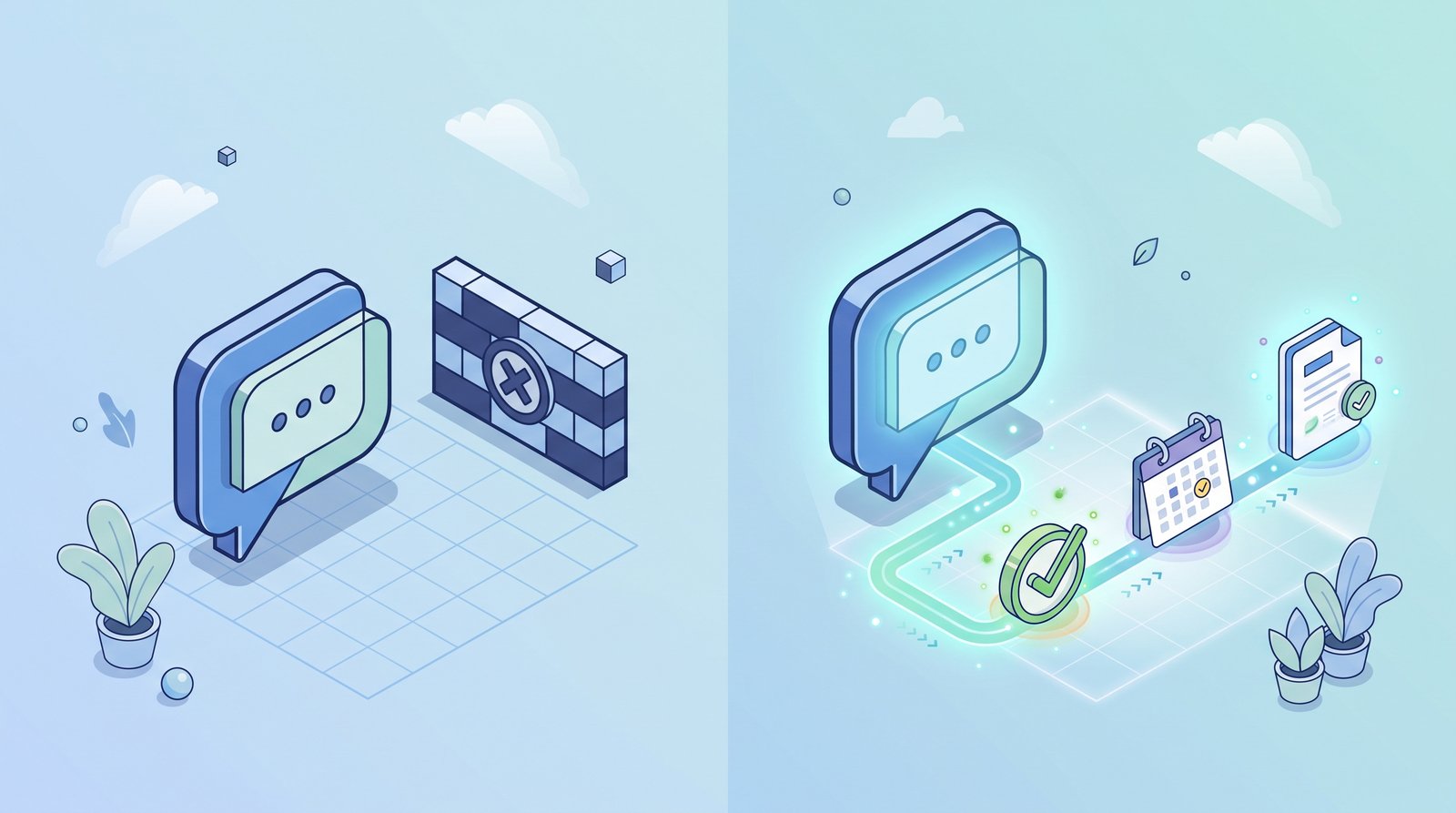
A business installs an AI chatbot, watches it answer customer questions competently, and reasonably concludes they've "done AI." Meanwhile, a competitor in the same space has deployed something that looks similar on the surface but functions completely differently — an AI system that doesn't just answer questions, but actually completes tasks: booking appointments, updating records, processing requests, all without human intervention. Both businesses are technically "using AI." Only one of them is capturing the actual value it makes possible, and the gap between the two is quietly becoming a real competitive disadvantage for businesses that don't understand the difference.
The Core Distinction
A chatbot, in its traditional form, is fundamentally a question-and-answer tool. A customer asks something, the chatbot responds with information, and the interaction ends there — any actual action required as a result of that conversation still falls to a human to complete manually.
An AI agent goes further: it doesn't just answer, it acts. It can check a calendar and actually book an appointment, look up an order and actually update its status, read an incoming request and actually route or resolve it — completing multi-step processes rather than simply providing information about them.
The distinction isn't about which is "smarter" in terms of the underlying AI model — the same model can power either type of system. The difference is about scope: whether the system is confined to conversation, or connected to real business systems and empowered to take real action within them.
Why This Distinction Costs Businesses Real Money
Scenario: A chatbot-only approach A customer asks about availability for a service. The chatbot correctly explains the general availability policy. The customer then has to separately call, email, or fill out a form to actually book — meaning a human still has to process that booking manually, check for double-bookings, and confirm the appointment. The chatbot saved the customer a phone call for the informational part, but the actual work of completing the booking still consumed staff time.
Scenario: An AI agent approach The same customer asks about availability. The AI agent checks the actual live calendar, confirms a specific available slot, books it directly, and sends a confirmation — the entire interaction, from question to completed booking, happens without any human involvement at all.
The difference in staff time saved between these two scenarios is substantial, and it compounds across every single interaction of that type happening every day. A business relying only on chatbot-level AI is still absorbing significant manual labor costs that agent-level AI could eliminate entirely for the same category of interaction.
Where This Gap Shows Up Most Commonly
Customer support and service requests A chatbot can explain a return policy; an agent can actually process the return, generate a shipping label, and update the order status — one ends in information, the other ends in resolution.
Appointment and booking systems A chatbot can describe availability; an agent can check real-time availability and complete an actual booking, eliminating the back-and-forth and manual confirmation work a purely informational chatbot still requires.
Lead qualification and sales support A chatbot can answer questions about a product; an agent can qualify a lead against specific criteria, update a CRM record, and automatically route qualified leads to the right salesperson — turning a conversation directly into a completed business process step.
Internal operations and reporting A chatbot can answer a question about a report; an agent can actually pull current data, generate the report, and deliver it on a defined schedule, without anyone needing to request it each time.
Why Businesses Default to Chatbot-Only Solutions
This isn't usually a deliberate strategic choice — it's often simply where many businesses start, because basic chatbot tools are widely available, relatively simple to deploy, and require less technical setup than a properly built AI agent connected to real business systems (calendars, databases, CRMs, inventory systems). The chatbot represents a lower barrier to entry, which makes it the common starting point, even when the actual business need would benefit far more from agent-level automation.
What Building an AI Agent Actually Requires (Beyond a Chatbot)
1. Integration with real business systems An agent needs to actually connect to the systems where real work happens — calendars, databases, CRMs, payment systems — rather than existing as an isolated conversational tool with no ability to touch anything outside the conversation itself.
2. Clearly defined permission and action boundaries Because an agent can take real action, not just provide information, the system needs carefully defined rules about exactly what it's allowed to do autonomously, and where a human checkpoint is still required — this is a meaningfully more involved design process than a purely conversational chatbot requires.
3. Robust error handling An agent that takes real action needs to handle situations that don't fit the expected pattern gracefully — a double-booking conflict, an out-of-stock item, an ambiguous request — since a mistake at the action level has real consequences, unlike a chatbot's worst-case failure of simply giving an unhelpful answer.
4. Proper orchestration between multiple steps Agent-level automation often involves multiple connected steps happening in sequence — this is the LLM orchestration layer that coordinates reading information, making a decision, and taking action, which requires more sophisticated system design than a single-turn conversational exchange.
How to Know Which One Your Business Actually Needs
Not every interaction needs to be agent-level — some genuinely are simple informational exchanges where a chatbot is entirely sufficient. The relevant question for any specific process is: does this interaction typically end with the customer or team member still needing to take a separate action afterward? If yes, that's a strong signal the process is a genuine candidate for agent-level automation, not just conversational AI.
The Real Cost of Staying at Chatbot-Level Too Long
Every process still requiring manual completion after an AI conversation represents ongoing labor cost that agent-level automation could eliminate — and this cost compounds daily, across every relevant interaction, for as long as the gap remains unaddressed. Businesses that recognize this distinction early and invest in agent-level automation for their highest-volume, most repetitive processes capture a real, measurable efficiency advantage over competitors still operating at chatbot-only capability.
#ai
#chatbots
#business
#automation
#technology
#customerexperience