
Mobile App
September 24, 2026
In-House Team vs Freelance Developer vs Agency: What's Right for Your App Budget
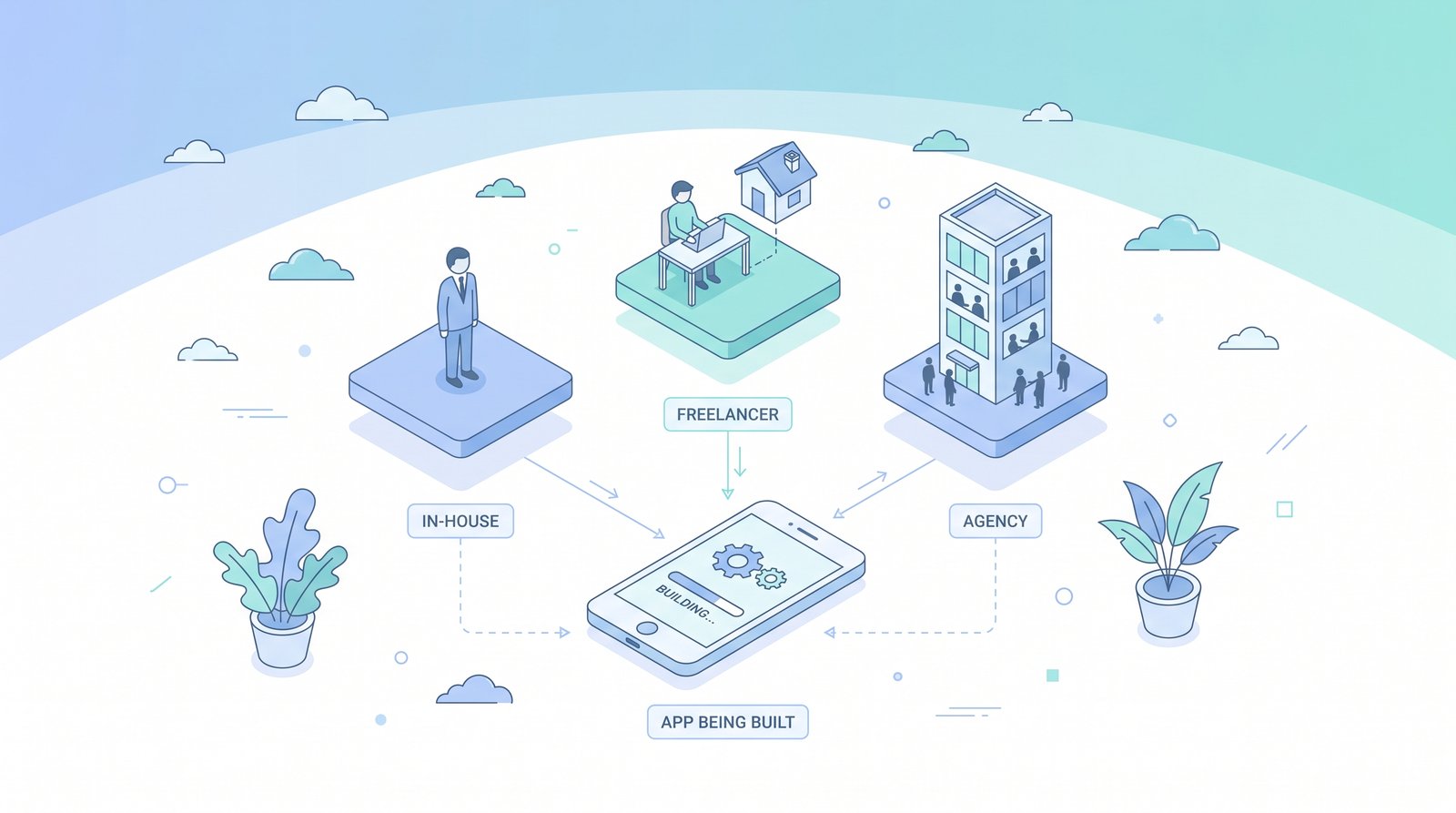
Deciding how to actually build a mobile app often gets less strategic attention than deciding what the app should do in the first place — yet the choice between hiring in-house, working with a freelance developer, or engaging an agency has real, lasting implications for cost, speed, quality, and how well the resulting product can be maintained and grown afterward. Each option carries genuinely different trade-offs, and the right choice depends heavily on a business's specific situation, not a universal "best" answer.
Option 1: Building an In-House Team
What this actually involves: Hiring one or more developers directly as employees, building internal capability and institutional knowledge that stays with the business long-term.
Where this genuinely makes sense:
The business plans significant, ongoing app development well beyond a single initial build — a continuous product roadmap rather than a one-time project Deep institutional knowledge of the business's specific systems and needs justifies the investment in dedicated, embedded staff Sufficient budget and scale exist to support the genuinely higher fixed cost of salaries, benefits, and ongoing management overhead
Real trade-offs to consider:
Meaningfully higher fixed costs than project-based alternatives, regardless of whether development work is consistently ongoing Longer hiring timelines and genuine difficulty finding and retaining strong technical talent, particularly for specialized skill sets Less flexibility to scale development effort up or down based on actual project needs at a given time Requires internal technical leadership or management capability to direct and evaluate the work effectively Option 2: Working With a Freelance Developer
What this actually involves: Engaging an independent developer, typically for a specific project or defined scope, without the ongoing commitment of employment.
Where this genuinely makes sense:
A relatively well-defined, contained project with clear scope and requirements Budget constraints make in-house or agency-level costs impractical for the current stage of the business The business has enough internal technical understanding to effectively manage and evaluate a freelancer's work directly
Real trade-offs to consider:
Quality and reliability vary significantly between individual freelancers — thorough vetting matters enormously, and even careful vetting doesn't eliminate this variability entirely A single freelancer typically covers a narrower skill range than a team, which can be a genuine limitation for projects requiring diverse expertise (design, backend development, testing, deployment all handled by one person) Availability and continuity risk — a freelancer becoming unavailable partway through a project, or after launch when ongoing maintenance is needed, can leave a business without support at a genuinely inconvenient time Less structured process and accountability compared to an agency's established project management systems, which can matter significantly for more complex projects Option 3: Engaging an Agency
What this actually involves: Working with an established team or company that handles the project collectively, typically bringing a broader range of skills (design, development, project management, testing) under one coordinated engagement.
Where this genuinely makes sense:
The project requires a diverse skill set — strong design, robust backend development, thorough testing — that a single freelancer is less likely to cover comprehensively The business values structured project management, established processes, and generally lower continuity risk compared to relying on a single individual Budget supports a higher cost than freelance options in exchange for the reduced risk and broader capability an established team provides
Real trade-offs to consider:
Generally higher cost than freelance options, reflecting the broader team and more structured process involved Potentially less direct, personal relationship with the specific individuals actually doing the hands-on work, compared to working directly with a single freelancer Project timelines and processes may be somewhat less flexible than a more informal, directly negotiated freelance arrangement A Practical Framework for Deciding
Start with an honest assessment of project complexity and scope. A straightforward, well-defined app with limited custom functionality is a reasonable fit for a skilled freelancer. A more complex project requiring diverse expertise across design, backend systems, and thorough testing more often benefits from an agency's broader combined capability.
Consider your own internal technical capability honestly. If nobody internally can effectively evaluate technical work quality or manage a freelancer's output directly, the more structured process and accountability an agency provides becomes genuinely more valuable, offsetting its higher relative cost.
Think realistically about the post-launch phase, not just the initial build. An app needs ongoing maintenance, updates, and bug fixes after launch — a plan for this ongoing phase matters as much as the initial development choice, and it's worth considering explicitly for whichever option is chosen, since "who handles this after launch" is a common gap that gets overlooked during initial planning.
Weigh your actual budget honestly against the real trade-offs, not just the headline cost. The cheapest option upfront isn't necessarily the lowest total cost if it results in quality issues, missed timelines, or the need for significant rework later — total cost of ownership matters more than initial quote comparison alone.
A Common Middle-Ground Approach Worth Considering
Many businesses, particularly at the startup or small business stage, find a genuinely effective middle ground: engaging a small, focused agency or a closely collaborating team of specialists, rather than choosing between a single freelancer and building full in-house capability. This can combine much of the broader skill coverage and structured process of a larger agency with more of the direct relationship and cost-consciousness associated with smaller, more focused engagements.
Red Flags Worth Watching For, Regardless of Which Option You Choose Vague or unclear communication about timeline, scope, or cost from the outset, before any commitment is made Reluctance to show genuine examples of previous, comparable work No clear plan or discussion for what happens after launch — ongoing support, updates, and maintenance Pricing significantly below typical market rates for the described scope, which often signals corners being cut somewhere not immediately visible The Bottom Line
There's no universally "correct" choice among these three options — each genuinely fits different business situations, project complexities, and budget realities. The businesses that make this decision well are the ones honestly assessing their specific project's actual complexity, their own internal capability to manage the work, and their realistic budget — including the often-overlooked post-launch phase — rather than defaulting to whichever option seems cheapest or most familiar without genuinely weighing the real trade-offs involved.
#appdevelopment
#freelance
#inhouseteam
#mobileapps
#agency