
AI Agents
October 1, 2026
The Hidden Cost of a Bad AI Assistant (And How to Spot One Early)
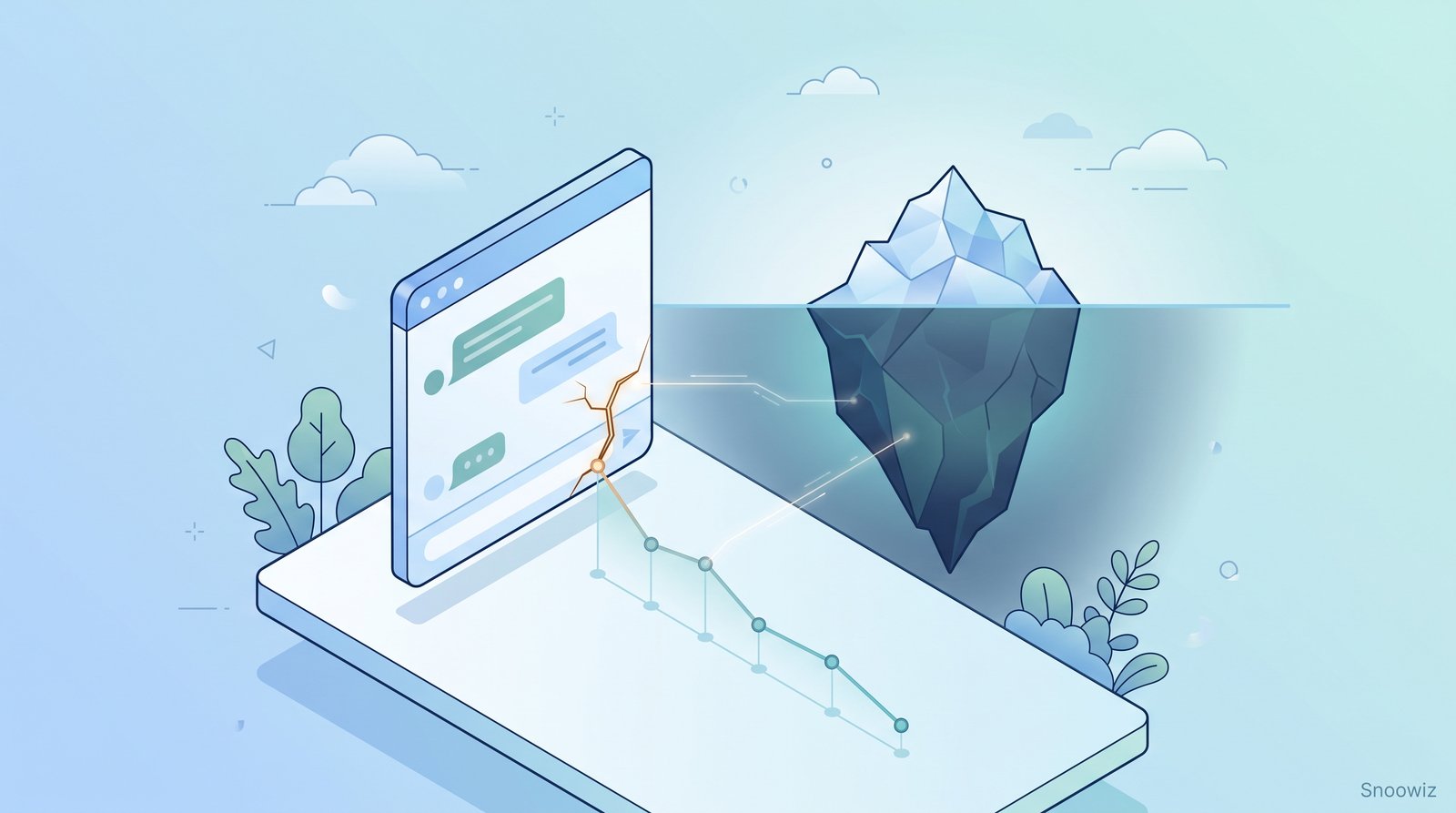
A business deploys an AI assistant, and on the surface, everything looks fine — conversations are happening, the dashboard shows activity, nothing has visibly broken. Meanwhile, quietly, in the background, that same assistant may be costing the business far more than it's saving — not through any single dramatic failure, but through a slow accumulation of small, largely invisible damage that rarely gets traced back to its actual source. Understanding what this hidden cost actually looks like, and learning to spot it early, is one of the most financially important things a business deploying AI can do.
Why This Cost Stays Hidden for So Long
Unlike a system outage or an obvious technical failure, a poorly performing AI assistant generally continues functioning — generating responses, maintaining uptime, showing activity in any basic usage dashboard. The damage it causes doesn't announce itself through an error message; it shows up instead as a slow decline in customer trust, a gradual increase in frustrated customers quietly churning rather than complaining directly, and missed opportunities that never get explicitly connected back to the AI assistant as their actual root cause.
Hidden Cost 1: Quiet Customer Churn
What this looks like: A customer has a frustrating or unhelpful interaction with an AI assistant — receiving a wrong answer, getting stuck in an unhelpful loop, being unable to reach a human when genuinely needed — and simply leaves, without filing a complaint or providing feedback that would flag the issue to the business.
Why it's hard to spot: Most customers who have a bad experience don't complain; they just quietly disengage, and that disengagement looks statistically identical to normal customer attrition from any other cause, making it genuinely difficult to trace the actual root cause without deliberate investigation.
The real cost: Every customer lost this way represents lost revenue that never gets attributed to the actual cause — meaning the business may continue operating the same flawed AI assistant indefinitely, unaware it's quietly contributing to churn that gets blamed on entirely unrelated factors.
Hidden Cost 2: Damaged Trust That Extends Beyond the AI Interaction Itself
What this looks like: A customer who receives a confidently wrong answer from an AI assistant doesn't just distrust the AI specifically — that experience often colors their broader perception of the business's overall competence and reliability, extending well beyond the single interaction itself.
Why it's hard to spot: This kind of broader trust erosion doesn't show up as a specific, traceable metric anywhere — it shows up diffusely, across slightly lower conversion rates, slightly more hesitant customers, slightly weaker word-of-mouth, none of which gets specifically connected back to a single AI interaction that happened weeks or months earlier.
The real cost: Trust, once damaged, is genuinely difficult and slow to rebuild — meaning the cost of a single bad AI interaction can extend meaningfully beyond that single interaction's immediate, visible outcome, affecting a customer relationship over a much longer timeframe than the original interaction itself.
Hidden Cost 3: Staff Time Spent Cleaning Up After the AI, Not Saved by It
What this looks like: An AI assistant intended to reduce staff workload instead generates a steady stream of confused, frustrated customers who end up needing extended human intervention to actually resolve what the AI mishandled — sometimes requiring more staff time to fix than if a human had handled the interaction directly from the start.
Why it's hard to spot: Businesses often track the raw volume of conversations an AI assistant handles as a success metric, without separately tracking how many of those "handled" conversations actually required significant human cleanup afterward — meaning the stated efficiency gain can be substantially overstated relative to the actual net time saved.
The real cost: The AI assistant may be actively adding complexity and cost to support operations rather than reducing it, while reporting metrics that superficially suggest the opposite.
Hidden Cost 4: Reputational Damage From Visible, Shareable Failures
What this looks like: A particularly bad AI interaction — a genuinely wrong or inappropriate response — gets captured and shared, whether on social media or simply recounted to other potential customers, creating reputational damage disproportionate to the actual single interaction that caused it.
Why it's hard to spot: This kind of damage often happens outside the business's direct visibility entirely — a screenshot shared privately, a frustrated recounting to friends or colleagues — meaning the business may never become aware a specific incident even happened, let alone its full reputational impact.
The real cost: A single sufficiently bad interaction, if shared or discussed even modestly, can do disproportionate damage to broader market perception — a cost that's genuinely difficult to quantify but very real in its actual business impact.
How to Spot a Bad AI Assistant Before These Costs Accumulate
1. Actively seek out negative interactions rather than waiting for complaints Rather than relying purely on whether customers complain, proactively review actual conversation transcripts regularly, specifically looking for confusion, frustration, or incorrect information — this surfaces real problems that passive monitoring, which only catches issues customers bother to report, will miss.
2. Track resolution rate, not just conversation volume Measuring how many AI conversations actually reach a genuine, successful resolution — rather than simply how many conversations occurred — reveals the real effectiveness gap that pure volume metrics obscure.
3. Monitor for patterns in human escalation A consistently high rate of conversations needing human escalation, or recurring specific types of questions the AI consistently struggles with, signals specific, addressable gaps rather than general, vague underperformance.
4. Directly ask a sample of customers about their AI interaction experience Occasional, direct outreach asking customers specifically about their experience with the AI assistant surfaces honest feedback that passive monitoring alone often misses, since most dissatisfied customers simply disengage rather than proactively providing feedback.
5. Run the fire-testing process regularly, not just at initial launch Periodically stress-testing the AI assistant against edge cases and realistic, messy customer scenarios — not just at the point of initial deployment — catches drift and degradation that can develop gradually as business information changes without a corresponding update to the AI's underlying knowledge base.
Why Catching This Early Matters So Much
The cost of a poorly performing AI assistant compounds the longer it goes unaddressed — more customers experience the same underlying issues, more quiet churn accumulates, more reputational damage spreads, all while the business may remain genuinely unaware of the actual scale of the problem due to how invisibly these costs typically manifest. Catching and addressing these issues early, through deliberate, proactive monitoring rather than passive hope, is significantly less costly than discovering the full scope of the problem only after it's had months to quietly compound.
The Bigger Lesson
An AI assistant that appears to be functioning normally on the surface isn't necessarily actually delivering genuine value — and the gap between "appears to be working" and "is actually working well" can be expensive precisely because it's so difficult to see without deliberate, active investigation. Businesses that build genuine, ongoing monitoring into their AI deployment — not just a one-time launch and forget approach — are the ones who catch and correct these hidden costs before they've had the chance to meaningfully damage the business.